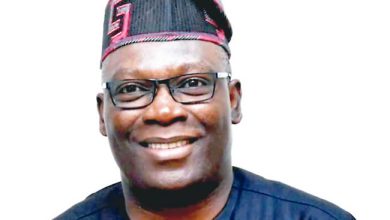
There comes a time in the political evolution of a society when the most important question is not simply who wants the job, but who is prepared for the job.
For Lagos in 2027, that question deserves an honest, dispassionate and intellectually rigorous examination.
If it’s not Dr. Kadri Obafemi Hamzat, who else?
And perhaps an even more fundamental question is this: if it isn’t broken, why the futile effort to fix it?
Lagos has spent more than two decades building a distinctive development model founded on continuity, institutional memory, long-term planning and successive administrations building upon the foundations laid by their predecessors.
The logical question, therefore, is whether Lagos should throw that accumulated experience overboard or consolidate it with a man who has been part of the architecture of the state’s development for over two decades.
Dr. Hamzat’s credentials speak loudly enough.
He holds a B.Sc. and M.Sc. in Agricultural Engineering from the University of Ibadan and a Ph.D. in System Process Engineering from Cranfield University, England. His academic journey is not merely impressive on paper; it is particularly relevant to the management of a complex metropolitan system like Lagos, where infrastructure, transportation, technology, data, urban planning and public administration are interconnected.
But Hamzat did not proceed directly from the classroom into politics.
He first acquired extensive professional experience across the private sector, academia, technology and international corporate environments, including Merrill Lynch, Morgan Stanley, Columbia University and Oando Plc, where he served as Chief Information Officer and Group Head of IT Strategy.
That background matters.
It means that before Lagos entrusted him with public responsibilities, he had already operated in environments where competence, systems, accountability and performance were not optional extras.
FROM TECHNOLOGY TO GOVERNANCE
In 2005, Hamzat entered the Lagos State Executive Council as Commissioner for Science and Technology under Governor Bola Ahmed Tinubu. He was retained by Governor Babatunde Fashola and subsequently became Commissioner for Works and Infrastructure. He later served as a technical adviser on works and infrastructure at the federal level.
These were not ceremonial appointments.
They placed him at the centre of some of the most consequential phases of Lagos’ transformation.
His tenure in Science and Technology was associated with the modernisation of government information systems and the deployment of technology in public administration. His subsequent responsibility for Works and Infrastructure brought him directly into the state’s physical development agenda.
Then came the Deputy Governorship. Since 2019, Hamzat has served as Deputy Governor of Lagos State and was re-elected in 2023. His political career therefore gives him a rare combination of technical competence, executive experience and political exposure.
This is not a man who needs an orientation course on Lagos. He knows the ministries. He knows the bureaucracy. He understands the relationship between policy and implementation.
He has worked with governors. He has worked with technocrats. He has worked with the private sector. He understands the political ecosystem.
Most importantly, he understands that governing Lagos is fundamentally different from merely campaigning for Lagos.
THE PERSEVERANCE FACTOR
There is another quality that should not be overlooked: perseverance. In 2018, Hamzat sought the APC governorship ticket. He subsequently became the running mate to Babajide Sanwo-Olu and was elected Deputy Governor in 2019. The ticket was returned to office in 2023. In 2026, the Lagos APC adopted him as its consensus governorship candidate for 2027.
That trajectory tells a story of patience and political maturity. Not every political journey proceeds in a straight line. Sometimes the mark of a serious political actor is the ability to remain committed to public service even when personal ambition does not immediately translate into political office.
Hamzat has demonstrated that patience.
LAGOS DOES NOT NEED EXPERIMENTATION FOR EXPERIMENTATION’S SAKE
Lagos is a state of over 20 million people, a global commercial centre and one of Africa’s most consequential urban economies.
Its problems are enormous.
Its opportunities are equally enormous.
The next governor will inherit an administration with ongoing programmes and long-term projects in transportation, infrastructure, housing, healthcare, education, technology, environmental management and economic development.
The question should therefore be whether the next administration will possess sufficient institutional understanding to sustain, improve and complete what deserves to be sustained and completed.
That is where continuity becomes a governance issue rather than merely a political slogan.
If it is not broken, why the futile effort to fix it? Continuity does not mean complacency. It does not mean that every policy must remain untouched.
It does not mean that Lagos has reached the destination. Far from it.
Continuity means retaining what works, correcting what does not, improving what can be improved and taking successful programmes to the next level.
Every serious development project requires institutional memory. Every successful city requires long-term planning. Every responsible government must understand that development is a relay race, not a 100-metre dash.
Why Start From Zero?
There is an understandable attraction to the politics of novelty.
A new face. A new slogan. A new promise.
But Lagos deserves more than novelty.
It deserves preparedness.
Hamzat offers something that cannot be manufactured overnight: decades of accumulated knowledge of Lagos governance.
He has sat on both sides of the policy table.
He has been a technocrat.
He has been a commissioner.
He has worked in the private sector.
He has served at the federal level.
He has been Deputy Governor.
He has participated directly in the political management of Lagos.
And he has done all of these while maintaining a reputation for intellectual engagement and technical depth.
The combination is unusual.
The Real Question For 2027
The question before Lagos should therefore not be reduced to personalities or political theatrics.
It should be about experience versus experimentation; institutional memory versus starting afresh; preparedness versus mere aspiration.
The Lagos APC decision to adopt Hamzat has now put his candidacy squarely before Lagosians. Ultimately, however, elections belong to the people.
Lagosians will examine the candidates, their records, their programmes and their capacity to meet the demands of the future and make their own judgment.
But those who advocate a departure from the established trajectory must equally answer a simple question:
What exactly is so broken about the Lagos development model that requires abandoning accumulated experience rather than improving upon it?
And if the argument is for change, then another question follows:
Change to what? Because change, by itself, is not a development strategy. Continuity, properly understood, is not the refusal to change.
It is the wisdom to know what must change, what must remain and what must be improved. That is why Hamzat’s preparedness deserves serious consideration.
With his academic depth, professional exposure, political experience, executive responsibility and intimate knowledge of Lagos governance, he comes into the 2027 conversation not as a political apprentice seeking an opportunity to learn on the job, but as a tested participant in the very system he seeks to lead.
If it’s not Hamzat, who else? That is not a question to be answered by propaganda. It is a question that should be answered by credentials, experience, preparedness, vision and the needs of Lagos. And for those demanding that Lagos abandon continuity, the burden of proof is simple:
If it’s not broken, why the futile effort to fix it? Lagos must move forward-not start all over again.
Mogaji (Hon) Oladejo, Spokesman for the Lagos APC