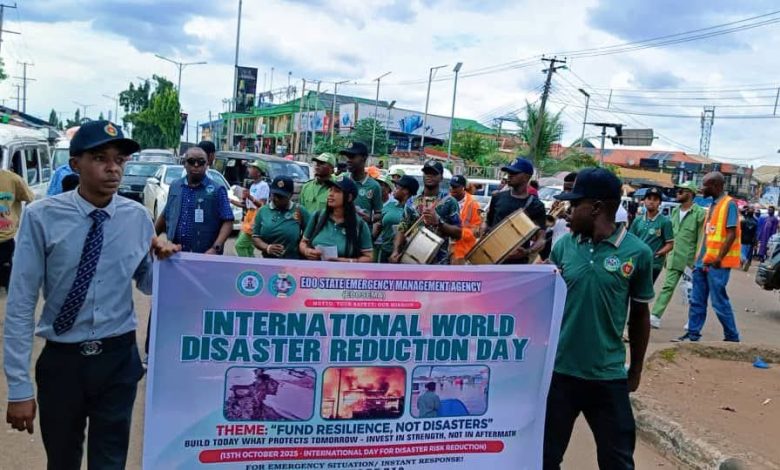
As a way of commemorating the 2025 International Day for Disaster Risk Reduction (IDDRR), the Edo State Government has urged its citizens to prepare ahead for disaster, rather than react to it, a reminder for the urgent need for Governments and communities to strengthen resilience before disasters strike.
The Secretary of the Edo State Emergency Management Agency (EdoSEMA), Hon. Jerry Idahosa disclosed the State Government’s investment on disaster management in line with this year’s theme, “Fund Resilience, Not Disasters”, urging proactive investment in preparedness rather than reactive spending after tragedy occurs.
He pointed out some progress the agency has made under Sen. Monday Okpebholo’s administration, which includes, the Oba Market fire in Benin City, the evacuation of flood victims, joint damage assessments in Owan communities, provision of relief and compensation to fire victims in Etsako, spearheading a statewide flood and erosion assessments.
According to him, “the State Government has progressed in intensifying disaster preparedness, early response and recovery coordination”.
The secretary further revealed that the agency had deepened collaboration with key partners including the National Emergency Management Agency (NEMA) and the World Health Organisation (WHO), noting that those partnerships have enhanced the Agency’s technical capacity and improved the State Government’s overall emergency readiness.
Idahosa also explained that EdoSEMA had increased community awareness campaigns, launched a toll-free emergency line (739) and promoted public sensitization in schools, markets and communities, emphasising that disaster preparedness is a collective responsibility.
He noted that there is still much work to do as several flood prone areas remain at risk, due to Illegal constructions which are obstructions to waterways, adding that the agency’s resources and technical capacity must be scaled up to meet growing challenges.
Idahosa stated, “The government must therefore deepen its commitment to disaster risk reduction by establishing a dedicated Resilience and Preparedness Fund, integrating risk assessments into urban planning and enforcing building regulations that discourage unsafe development. Consistent investment in early warning systems, flood control infrastructure, and community training will save the State far more than emergency expenditure after a disaster”.