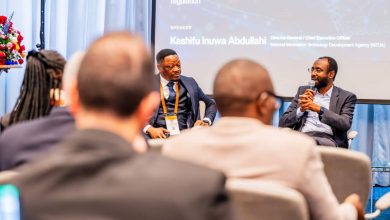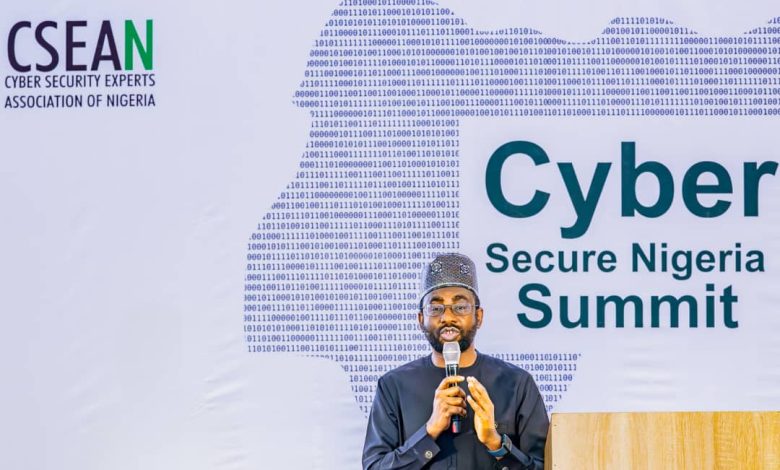
The Director-General of the National Information Technology Development Agency (NITDA), Kashifu Inuwa, has said that Nigeria is taking decisive steps to safeguard its digital future by strengthening cybersecurity, enhancing infrastructure, and building human capacity to harness the power of Artificial Intelligence (AI).
Inuwa stated this while delivering a keynote address titled “Securing the Digital Economy: Strengthening Infrastructure and Harnessing the Power of Artificial Intelligence” at the Cyber Nigeria Summit, organised by the Cybersecurity Experts Association of Nigeria (CSEAN).
He described the digital economy as the heartbeat of Nigeria’s development agenda, noting that while ICT currently contributes about 17 percent to the country’s GDP, digital technologies now influence nearly every sector of the economy.
According to him, the service sector alone accounts for about 58 percent of national output, demonstrating the deep integration of digital tools into everyday life.
Inuwa cautioned that the rise of AI has transformed the dynamics of cybersecurity. While AI drives productivity and innovation, it also provides cybercriminals with advanced tools to launch more precise and large-scale attacks.
“Cybercrime now costs the world over 10 trillion dollars annually, making it the most lucrative form of crime globally. The World Economic Forum ranks cybersecurity among the top five global threats, showing that our strategies must evolve beyond physical protection,” he said.
The NITDA boss stressed that securing Nigeria’s digital economy must begin with designing infrastructure that prioritises security from the foundation.
He noted that digital infrastructure now extends beyond servers and networks to include utilities, telecommunications, and even autonomous vehicles.
“If a hacker gains access to an autonomous car, the consequences could be disastrous,” he warned.
Inuwa emphasised that AI systems rely on three critical elements, data, computing power, and algorithms all of which must be adequately protected.
He identified human error as the leading cause of cyber incidents globally, accounting for between 90 and 95 percent of breaches. Despite two decades of awareness campaigns since the introduction of Cybersecurity Awareness Month in 2004, he said, this figure has remained largely unchanged.
“Cybercriminals exploit human weaknesses because it’s easier to manipulate behaviour than to break through advanced systems,” he explained.
Inuwa outlined Nigeria’s cybersecurity framework, which is built on four strategic pillars: governance, capacity building, incident management, and collaboration.
Under the governance framework, he said, the Nigerian Cybercrime Act provides the foundation for coordination and accountability. The law, recently amended to reflect emerging digital realities, is complemented by a Presidential Executive Order designating critical digital information infrastructure as part of Nigeria’s national assets.
On capacity building, the NITDA DG highlighted the growing global demand for cybersecurity professionals, with a current shortfall of 4.4 million workers worldwide — including more than 140,000 in Nigeria. He described this as an opportunity for national empowerment given the country’s youthful population.
Through initiatives such as the 3 Million Tech Talent (3MTT) programme, Inuwa said the government aims to train Nigerians in 12 high-demand digital skills, including cybersecurity. He also referenced the Digital Literacy for All Initiative and the National Digital Literacy Framework (NDLF), which target 95 percent digital literacy by 2030 and 70 percent by 2027.
Starting next year, he announced, digital literacy — including cybersecurity — will be integrated into the school curriculum from kindergarten to tertiary levels, to nurture a digitally conscious and responsible generation.
Inuwa further revealed that the National Cybersecurity Coordination Centre (NCCC), established under the Office of the National Security Adviser (ONSA), is now fully operational and coordinates cyber incident responses nationwide. Sectoral Computer Emergency Response Teams (CERTs) have also been created in key sectors such as finance, communications, and law enforcement to ensure a unified national response.
He emphasised that collaboration remains essential for success, as cybersecurity cannot be managed in isolation. Nigeria, he said, works closely with the African Union (AU), Smart Africa, international CERTs, and major global technology companies to strengthen collective defence mechanisms.
The NITDA DG urged Nigerians to adopt good cyber hygiene by using strong passwords, enabling multi-factor authentication, and avoiding phishing scams. He also encouraged prompt reporting of cyberattacks, stressing that transparency is vital for collective resilience.
In partnership with the ONSA, Inuwa added, NITDA is currently developing a National Cybersecurity Architecture to promote accountability, enhance information sharing, and strengthen national cyber defence.