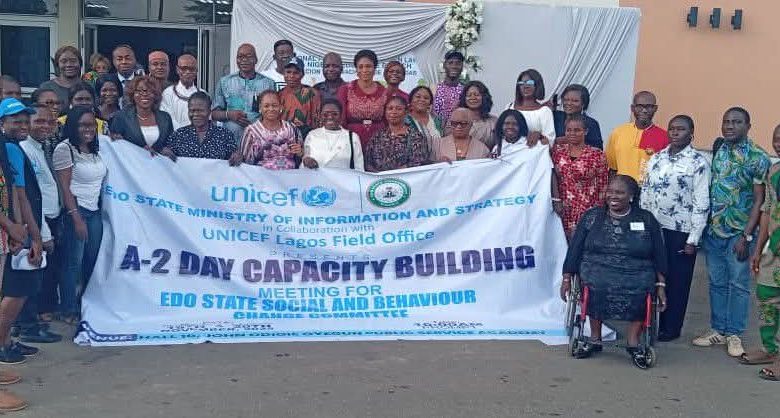
The Edo State Government, in collaboration with UNICEF and other key stakeholders, has conducted a two-day capacity-building workshop for members of the Social and Behavioural Change (SBC) Committee to strengthen community-led interventions that promote the wellbeing of children and women across the state.
Held at the John Odigie Oyegun Public Service Academy (JOOPSA) in Benin City, the workshop brought together policymakers, communication experts, programme officers and grassroots advocates for an intensive learning and engagement session.
Declaring the event open, the Permanent Secretary, Ministry of Information and Strategy, Dr. Peter Osagie, commended the SBC Committee for its role in reinforcing institutions that promote good governance and improve public trust in government programmes. He emphasized the importance of equipping committee members with the skills required to implement structured behavioural change initiatives in communities.
In her remarks, the SBC Committee Programme Director, Mrs. Rose Imonikhe, said the Committee’s mandate focuses on addressing issues affecting children and women, adding that the workshop was essential to achieving that goal.
A UNICEF representative, SBC Specialist and Field Officer, Aderonke Akinola-Akinwole, delivered a presentation on the evolution of Communication for Development (C4D) into the broader Social and Behavioural Change (SBC) framework. She explained that SBC moves beyond communication by examining the motives behind human behaviour, creating enabling environments, and ensuring interventions are community-led and human-centred.
Akinola-Akinwole outlined key tools used in driving behavioural change, including advocacy, community engagement, social mobilisation, edutainment, theatre-for-development and media campaigns. She stressed the importance of continuous, data-supported feedback to ensure that interventions remain effective and responsive to community needs.
Participants also discussed the importance of crafting audience-specific messages, using local languages, amplifying community voices, and engaging qualified experts during media appearances. Additionally, they were encouraged to incorporate security considerations into SBC planning, especially in vulnerable or conflict-prone communities where communication strategies must be carefully tailored.
The workshop further explored four modern SBC approaches, Gamification, Positive Deviance, Collective Change and Behavioural Insights.