The Ogun State Government has set an ambitious target of generating ₦500 billion in Internally Generated Revenue (IGR) to finance the 2026 fiscal year.
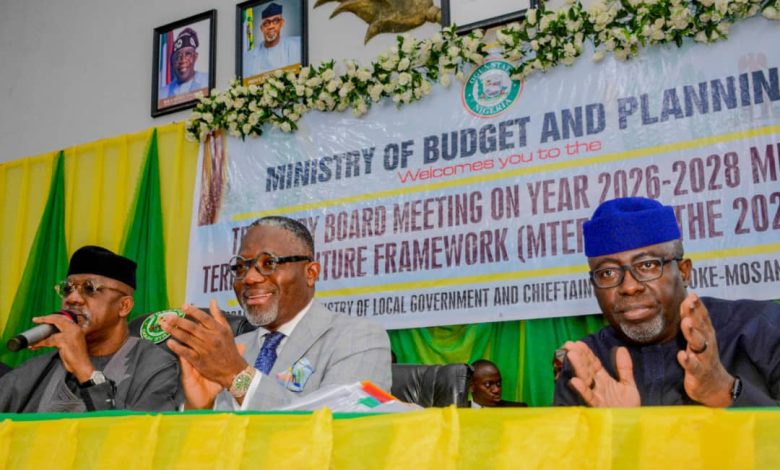
Governor Dapo Abiodun gave the charge on Tuesday during the Treasury Board meeting on the 2026–2028 Medium-Term Expenditure Framework (MTEF) and the 2026 Budget held at the Obas Complex, Oke-Mosan, Abeokuta.
The governor noted that as Nigeria’s industrial hub, Ogun State would leverage its strategic proximity to Lagos State—the nation’s largest economy—and its vast landmass of over 16,000 square kilometres to achieve the target.
“This State has no business generating less than ₦500 billion a year, and that has to be our target. By the time we are leaving in 2027, Ogun State’s revenue should rise to about ₦750 billion. That is what ambition looks and feels like.”
He specifically tasked the Ogun State Internal Revenue Service (OGIRS) to contribute ₦250 billion of the total target, while other key revenue-generating agencies—such as the Ogun State Property and Investment Corporation (OPIC), the Bureau of Lands, the Ministry of Education, Science and Technology, and the Ministry of Housing—were directed to scale up their efforts.
Abiodun emphasized that every Ministry, Department and Agency (MDA) had a critical role to play in achieving the goal, describing them as “pieces of a jigsaw that must fit together to complete the bigger picture.”
The governor urged agencies to adopt creativity and innovation in their revenue drive, commending those that had already demonstrated commendable results.
On the deplorable condition of Kara, near Isheri, Abiodun reiterated his administration’s commitment to urban renewal, stressing that the area would be cleared and redeveloped.
He revealed that an inter-ministerial team comprising officials from the Ministries of Environment, Physical Planning and Urban Development, the Bureau of Lands, and other relevant agencies had been set up to handle enumeration, compensation, and relocation efforts necessary for the corridor’s transformation.