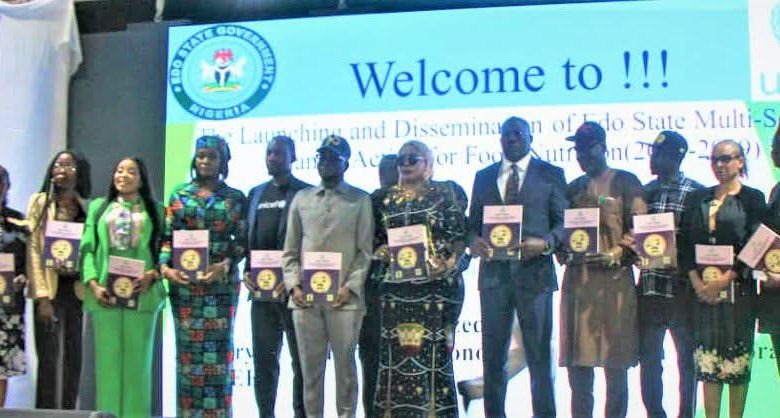
The Edo State Government has launched a four-year Multi-Sectoral Plan of Action for Food and Nutrition (2025–2029) aimed at reducing malnutrition and improving the nutritional wellbeing of residents across the state’s 18 local government areas.
The initiative, coordinated by the Ministry of Budget and Economic Planning, seeks to integrate health, agriculture, education, water, sanitation, and social protection efforts to address food and nutrition insecurity in the state.
Speaking at the launch in Benin City, Governor Sen. Monday Okpebholo, represented by the Commissioner for Health, Dr. Cyril Adams Oshiomole, reaffirmed his administration’s commitment to improving the wellbeing of families, especially women and children.
He noted that the plan reflects the government’s determination to build “a healthier and more productive population,” adding that food and nutrition security extend beyond health to economic and social development.
“Addressing malnutrition requires more than good intentions — it demands strategy, coordination, and strong partnerships,” the governor said. “Our vision is simple but powerful: to make Edo State a place where no child suffers from malnutrition, where mothers are healthy and productive, and where every family can thrive.”
Governor Okpebholo emphasized that success would be measured by effective implementation, pledging that his administration would mobilize resources, strengthen institutions, and enforce accountability mechanisms to track progress. He described the plan as a “roadmap and a call to action” aligned with the Edo State Development Plan and the Sustainable Development Goals (SDGs) 2 and 3 — Zero Hunger, Good Health and Well-being.
He also commended the Ministry of Budget and Economic Planning for leading the process in collaboration with development partners, civil society organizations, and technical experts, while urging Edo residents to take ownership of the initiative.
Commissioner for Budget and Economic Planning, Dr. Elizabeth Ebosele, described adequate nutrition as vital to human capital development and economic growth. She highlighted the state’s collaboration with UNICEF and other partners to ensure that no child in Edo suffers from malnutrition.
“The plan was developed through broad stakeholder engagement and is designed to deliver measurable, sustainable nutrition outcomes,” Ebosele said.
State Nutrition Officer, Mrs. Phil-Imade Amenze Nekpen, presented an overview of the state’s nutrition profile, identifying high rates of anaemia among children under five and women of reproductive age as a major concern. She listed poverty, poor public health, and disruptions to food systems as the main drivers of malnutrition.
UNICEF Officer in Charge, Lagos Office, Mr. Muhammad Okorie, commended the Edo State Government’s political will and called for sustained budgetary support for implementation. The WHO State Coordinator, Dr. Eyo Nora, urged the state to leverage existing funding platforms, while NPHCDA State Coordinator, Mr. Lawani Osawe, described the initiative as a milestone in Edo’s health and nutrition agenda.
The event featured the official unveiling of the Multi-Sectoral Plan of Action for Food and Nutrition (2025–2029) and the investiture of Governor Okpebholo as Nutrition Ambassador and Best Performing Governor by the Nutrition Society of Nigeria for his commitment to advancing nutrition in the state.