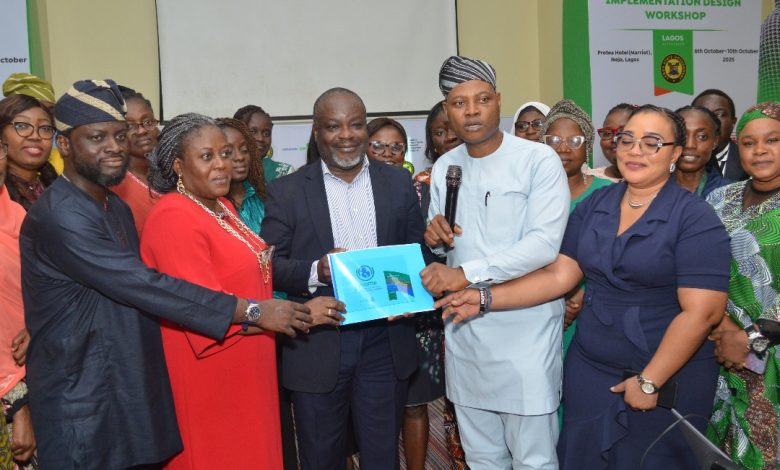
In a bid to prevent maternal and neonatal deaths, The Lagos State Government, through the Ministry of Health Permanent Secretary, Dr. Olusegun Ogboye, has inaugurated the State MAMII Task Force and received the Lagos domesticated action plan from the Federal Ministry of Health at the ongoing five-day Co-creation Workshop on the Maternal and Neonatal Mortality Reduction Innovation Initiative (MAMII), held at Protea Hotel, Ikeja.
The MAMII initiative, nationally led by the Federal Government through the Federal Ministry of Health and Social Welfare, aims to drastically reduce mother and infant deaths through a sector-wide approach that assembled the federal, state, and community stakeholders.
Representing the Lagos State Government, Dr. Ogboye at the fourth day of the workshop session, emphasized that the co-creation process was designed to adapt the national strategy to Lagos-specific realities. “This workshop is about working with our federal partners to ensure Lagos adopts and domesticates the nationwide MAMII strategy,” he said.
He explained that the state had identified Ibeju-Lekki Local Government as a topmost area for intervention due to its high maternal mortality rate. Adding that the newly inaugurated MAMII Task Force would be responsible for implementing, monitoring, and evaluating the domesticated action plan, which is expected to yield good results soon.
Also speaking at the workshop, The National Lead for MAMII, Dr. Dayo Adeyanju, described the workshop as a critical milestone in the nationwide effort to curb maternal and neonatal deaths. He said the innovation behind MAMII lies in its broad and multi-sectoral approach, which moves beyond health-sector silos to engage education, transport, and social welfare systems.
He added, “MAMII is a sector-wide approach that assembles everyone from the federal to the community level to the same table. We have analyzed the drivers of maternal deaths and are designing responses that address both physical and financial barriers to care,”
Adeyanju further disclosed that the Lagos Action Plan would not be a paper document but a living implementation framework. “This plan will be costed and integrated into the state’s annual operational plan and budget. Partners and federal agencies will also know where to plug in resources to close identified gaps,” he said.
Speaking on behalf of the pilot LGA, Medical Officer of Health for Ibeju-Lekki Local Government, Dr. Kehinde Oshosanya, described the initiative as timely and transformative. He stated, “Ibeju-Lekki has peculiar challenges — a vast landmass, rapid migration, and a mix of literacy levels — all of which contribute to its high maternal mortality rates. MAMII provides us with the opportunity to tackle these head-on,” he said.
Dr. Oshosanya noted that the sustained paticipation of stakeholders would drive this project, which will bring resources, learning opportunities, and stronger partnerships to the local government. He added, “Our communities and health workers will greatly benefit”.